
Caroline County Warrant Checks
Caroline County publishes no confirmed public active-warrant search, so a solid warrant check pairs the court record with the office that serves or holds the process. Start by naming the question. Is it a traffic or misdemeanor case, a felony, a juvenile or domestic matter, a possible arrest warrant, or custody? The Caroline County warrant check page lays out the full official search and contact sequence. Before you call, gather the person's full legal name, alternate spellings, the locality, and any case number or hearing date you know. Give a date of birth only when a court or agency asks for it. And keep 911 out of it. Records questions have their own route.
- Use the Virginia court-information page and select the Caroline court that fits the matter.
- Read a result as a case lead, then ask the correct clerk whether a warrant entry or later order is recorded.
- For a wanted-person concern, follow the Sheriff FAQ. It does not give a yes-or-no answer by phone.
- Use the Sheriff’s FOIA route for an existing policy or report, not for a new list the office does not keep.
- Before an appearance, payment, surrender, or statement, ask counsel or the issuing court what procedure applies.
No Public Caroline Warrant Search
The Caroline County Sheriff posts no public warrant form, no downloadable active-warrant list, and no confirmed most-wanted roster. That limits any do-it-yourself warrant search. The office does publish its wanted-person FAQ, along with contact details, a public-information archive, a courts page, and records-request instructions. The FAQ is blunt about one thing: wanted-person information never goes out over the phone. Instead, the Sheriff's documented route is to come to the office in person, or to call dispatch at 804-633-5400 and ask that a deputy come to you. Save 911 for true emergencies. The state court search helps with case details, but it cannot replace that Sheriff route. The Caroline Sheriff FAQ interface gives the office's own instructions on how wanted-person requests work.
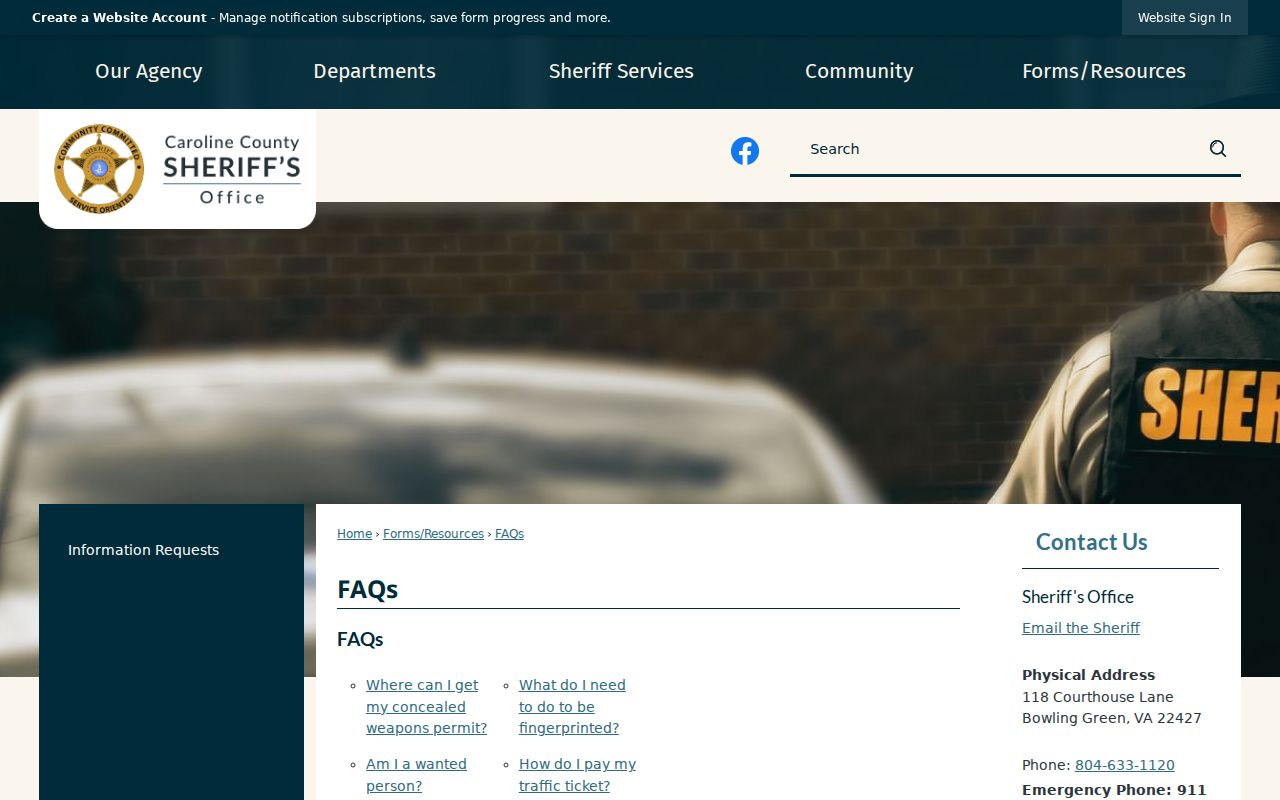
This is the Caroline County Sheriff's public information page. It shows the office's contact route, not a live warrant list or any names.
Warrants in Caroline County: The Main Types
Virginia works with several kinds of court and law-enforcement process, and the label on the order matters. A summons asks for an appearance. A search warrant authorizes a search under its own terms. An arrest warrant goes further and commands an officer to bring a named person before the proper court in Caroline County.
| Process | How it may arise | Caroline route |
|---|---|---|
| Arrest warrant | Complaint, oath, and probable-cause review | Magistrate or authorized officer; court and sheriff records |
| Bench or FTA process | Missed required appearance or noncompliance | Relevant GDC, Circuit, or JDR clerk |
| Capias | Specified charging or fine-default process | Exact court order controls |
| Search warrant | Probable cause to search a place or property | Affidavit and return follow separate disclosure rules |
| Traffic process | Noncompliance in a covered traffic case | Caroline GDC and the court-to-DMV route |
Caroline County Court Levels Matter
Caroline County sits in the 15th Judicial District and the 15th Judicial Circuit. The General District Court takes traffic cases, misdemeanors, and felony preliminary hearings. Felonies themselves belong to Circuit Court. Juvenile and Domestic Relations handles juvenile, domestic, and related matters. Magistrates review complaints and can issue warrants, yet they are not trial-court clerks. So a case may start with a magistrate and later sit in a different court, while the Sheriff serves process and holds law-enforcement records and the clerk keeps the court file.
Caroline County Warrant Records: What They Show
No public Caroline County warrant listing exists. The fields described here cover process records generally. An agency file may hold more than a public case result shows, and some fields may be withheld or redacted.
| Issuing authority | Magistrate, judge, or other authorized officer, depending on process. |
|---|---|
| Process type | Arrest warrant, bench or FTA process, capias, summons, traffic order, or search warrant. |
| Case and court | Locality, court, case number, and the appearance or return instruction. |
| Basis and offense | Complaint or affidavit, probable-cause basis, and offense description when public. |
| Service and status | Execution, return, bond terms, recall, or disposition if held in the accessible record. |
A Case Search Is Not Warrant Status
Virginia's court-information page lets you search by locality, name, case number, or hearing date, but it promises no active-warrant field. Start at the official entry point: the Virginia court case-information page. A Caroline County case can show a summons or a resolved matter while saying nothing about current service status. A blank result may just mean a different court, another spelling, a restricted file, or a gap in system coverage. Neither outcome is a legal clearance. Confirm what you find with the clerk.
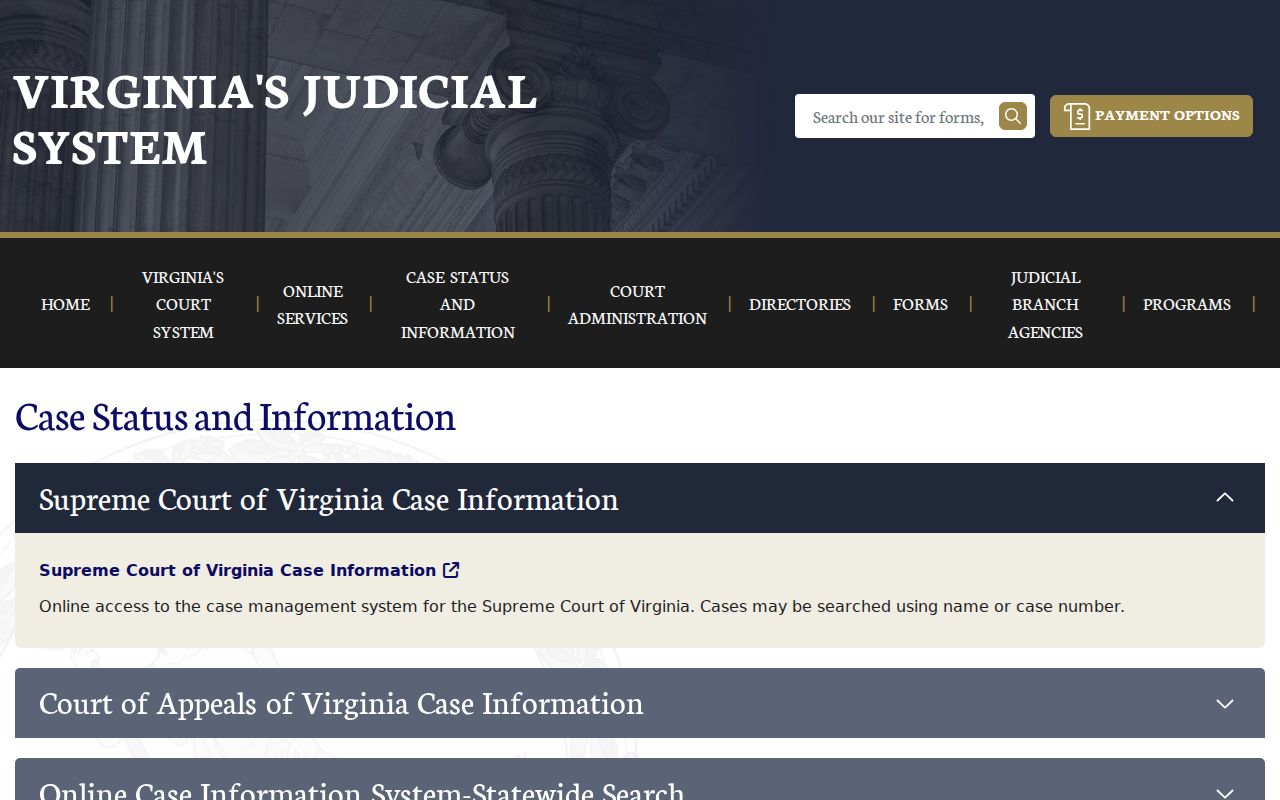
This landing screen is a route to court case tools for Caroline County. Treat it as a doorway, not a warrant database.
Caroline County Warrants: Who Issues, Who Serves
A magistrate or authorized officer reviews a sworn complaint and probable cause before an arrest warrant issues in Caroline County. A judge can also issue process after a missed court obligation. Officers execute the order, and the Sheriff adds courthouse security and transport. The serving agency and the court clerk each hold different parts of the record.
Caroline County Sheriff’s Office
118 Courthouse Lane, Bowling Green, VA 22427
Main: 804-633-1120 · Dispatch: 804-633-5400
Caroline General District Court
111 Ennis Street, Bowling Green, VA 22427-0511
804-633-5720
Each Caroline County office describes only its own part of the process. A call to dispatch never replaces confirmation from the court.
Courthouse Lane and Ennis Street Routes
Use the office that holds the record: GDC is at 111 Ennis Street; Circuit Court is at 112 Courthouse Lane, Suite A; the Sheriff is at 118 Courthouse Lane. The Circuit page lists 804-633-5800, while the county clerk page lists 804-633-1090; official pages differ.
JDR lists 804-633-9550 and 804-633-4061. Confirm the right clerk before visiting; published hours are not a warrant appearance appointment. No local security, parking, or walk-in clearance instructions were found.
Caroline’s County Administration Building at 212 N Main Street is a general county service location, not the documented court-record route.
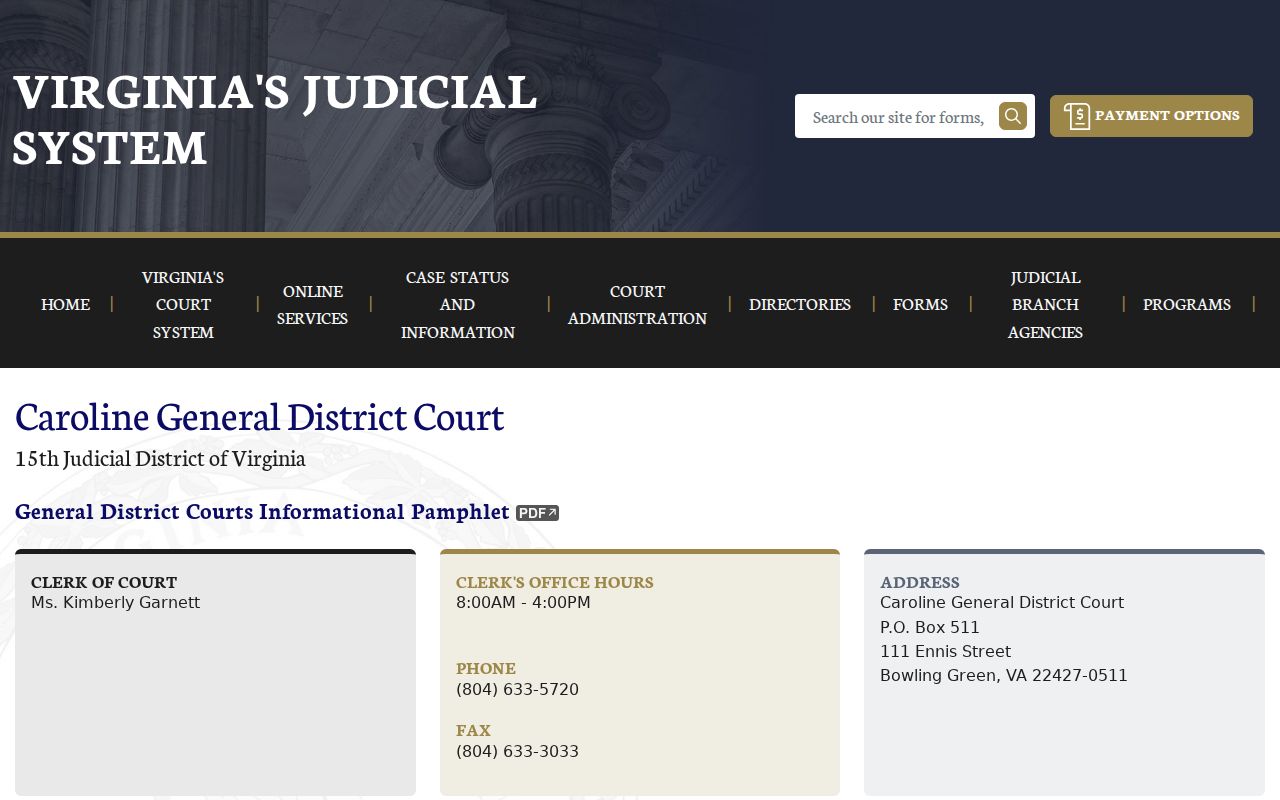
The Caroline County GDC page names its own docket and clerk contact. That contact stands apart from Circuit Court and the Sheriff's Office.
Handling a Caroline County Warrant
If a search or a notice raises a concern in Caroline County, confirm the process type and the issuing court first. Then ask counsel or the clerk whether a hearing, motion, appearance, bond condition, or payment issue applies. The county publishes no local surrender, recall, or walk-in clearance form.
Before appearing: get legal advice and confirm the correct court and procedure. A public case result does not promise a same-day recall, no-arrest visit, or bond amount.
Virginia Code §19.2-128 covers willful failure to appear and security forfeiture. It sets no walk-in process for Caroline County. The clerk can pull the court file, and a lawyer can say how the order applies to one person's case.
Caroline County Fine Plans and Warrants
Payment plans cover fines and costs. They do not recall an arrest warrant or an FTA warrant on their own. Caroline GDC expects fines and costs paid on the court date, and unpaid balances after 90 days may hit collection enforcement. The policy allows one extension. Deferred periods, installments, and possible community service are options for fines and costs, never restitution. Circuit Court policy works differently: a written financial statement supports requests within 30 days, and its modification, default, DMV notice, and community-service terms stand apart. Ask the clerk which policy fits your Caroline County case. Form DC-211 deals with payment agreements, not warrant status, and no bond-window hours, amounts, or payment methods are posted. For current forms and local policies, use the Virginia court payment-policy page for Caroline County cases.
Warrant Record Access Under Virginia Law
Virginia FOIA asks for a reasonably specific request for an existing record. Agencies must respond within five working days. The answer may provide, withhold, or redact a record, or say none exists. FOIA does not build a new warrant database. It owes no legal answer either. Court dockets follow separate court-access rules. Ask the clerk for court files and the Caroline County Sheriff for law-enforcement records.
Access rules:
Virginia Code §2.2-3704 sets request, response, and cost rules for existing public records.
Virginia Code §16.1-301 restricts juvenile law-enforcement records.
Virginia Code §2.2-3706 covers criminal investigative records, redactions, and access limits.
Virginia FOIA Requests Need Specific Records
The Sheriff's Information Requests page handles requests for an existing policy, report, or law-enforcement record in Caroline County. FOIA Officer Sergeant Karl Eichenmiller is listed there. The main number is 804-633-1120. Name the record type and date range; the office still need not build a person-by-person warrant report. Investigative or private material may be withheld. County FOIA routes Sheriff, Circuit clerk, and prosecutor requests separately, so court-file requests go to the right clerk rather than County Administration. A five-working-day response never promises a record exists or that every detail is released. Start at the Sheriff information-request page.
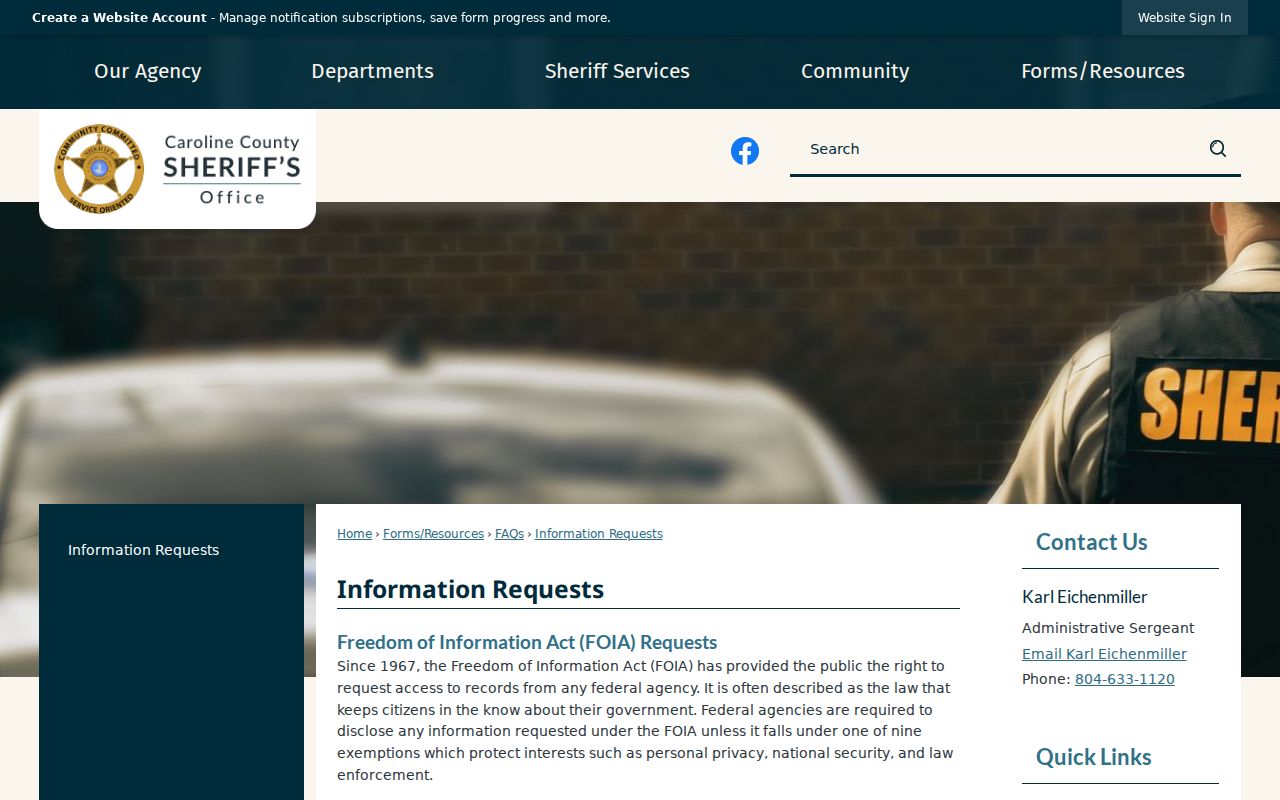
The request page is a records route, not a live warrant-status search.
City Warrant Records in Caroline County
Census 2020 counts two incorporated towns in Caroline County, not five. Neither has a separate municipal court or warrant portal. Bowling Green runs a town police department. Port Royal's site covers town government only, so court business still goes to Caroline GDC, Circuit, or JDR as the case requires.
Bowling Green Warrants
1,168 people in the 2020 Census table. Town police service and county-seat context, with court records routed to Caroline courts.
Port Royal Warrants
196 people in the 2020 Census table. Town Hall is a civic contact, not a confirmed warrant-record office.
Caroline County Town Warrant Routes
Bowling Green Police holds town-code constable powers in criminal cases. It publishes no municipal criminal docket or warrant list. Port Royal's site sticks to Town Hall, code, and council matters, and no police or warrant portal appears there either. Town process still follows the Virginia court map. Ask Bowling Green Police about town services, the right clerk about court cases, and the Caroline County Sheriff FAQ about wanted-person concerns. Use the court, Sheriff, and records routes already listed here. Census figures describe town populations; they do not count warrants.
Federal Warrants Use a Separate Court
Caroline County sits in the Richmond Division of the Eastern District of Virginia. Federal process is separate. PACER searches federal dockets, not active warrants. Sealed matters may not appear at all. Rely on federal counsel and the federal court route; a docket still is not warrant-status confirmation, and the EDVA jurisdiction page shows the Richmond Division.